BY JIM ROBERTS
KEMPSVILLE — Dr. Cynthia Romero and Dr. Arlene Fontanares aren’t related by blood, but they are sisters — or perhaps at least cousins — in that they were raised by dozens of “aunties and uncles” in Virginia Beach’s vibrant Filipino community.
They were among the first girls to take dance lessons from the Filipino Women’s Club of Tidewater, and their parents were instrumental in founding the Council of United Filipino Organizations of Tidewater in 1976.
Today, as CUFOT approaches its 50th anniversary, Romero and Fontanares serve as chairperson and first vice chairperson, respectively.
“We grew up watching the whole process,” Fontanares said during a recent interview. “I remember … there were a bunch of uncles and aunties sitting in someone’s living room. I think I was crawling on the floor playing with somebody’s baby, and they’re talking back and forth. … We became very good friends because all the kids got thrown in the corner. We were just happy to have each other.”
The “talking back and forth” was about uniting four important local organizations — the aforementioned Filipino Women’s Club, the Batangas Association of Hampton Roads, the Filipino-American Veterans of Hampton Roads and Ladies of Auxiliary, and the United Ilocano Association of Tidewater — as CUFOT.
“With these multiple organizations … there was a lot of overlap and conflicts as far as events,” Romero said. “So several of the leaders came together to develop an umbrella organization to help coordinate, foster networking and really help communicate where things are happening so we can support each other and not have three events happening on the same date and time.”
CUFOT now comprises more than 20 member organizations, including the Philippine Rondalla Ensemble of Virginia and the School for Creative and Performing Arts. The council’s greatest achievement, though, may be the Philippine Cultural Center of Virginia, which opened in 2000 on Baxter Road — adjacent to the Kempsville Greens golf course.
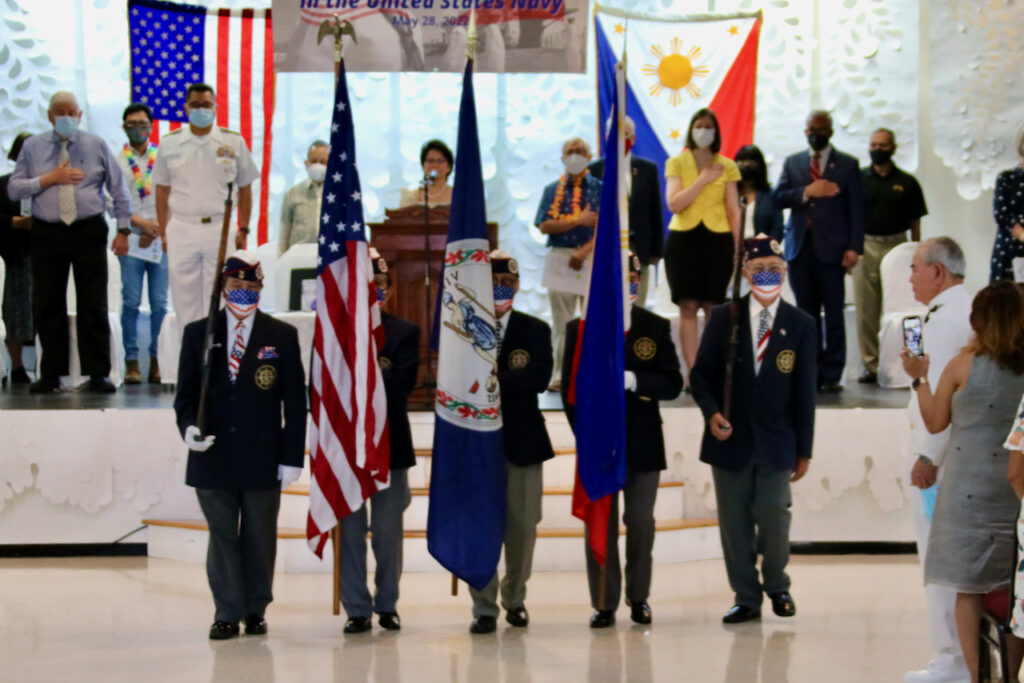
Originally financed by 32 Filipino families who cosigned on a $1 million loan, the PCC serves as a central meeting place for all of CUFOT’s member organizations as well as a venue to community functions and events such as candidate forums.
“On June 24, 2000, we were able to open our doors and conduct the inauguration and celebration of the Philippine Cultural Center,” Romero said. “So June of 2025 is going to be the 25th anniversary of having this dream become a reality. Then in January 2026, we’ll actually be celebrating the 50th anniversary of starting CUFOT as the umbrella organization with that common dream of building a place.”
Events central to public life have included a forum hosted in late 2023 by the Hampton Roads Black Caucus for Virginia Beach City Council candidates in a special election for a voting district that includes the immediate community.
And, just this past month, a question-and-answer forum with mayoral candidates in Virginia Beach was held at the center. The event was hosted by CUFOT and the Filipino American Community Action Group.
Over time, the PCC has evolved into a multi-use facility that can host events for up to 1,000 people. In addition to forums, the center has featured Zumba classes, parties, pageants and more.
Romero said the cultural center has even hosted consular services for the Embassy of the Republic of the Philippines.
Phil Diaz spends time at the PCC every day. In addition to serving as CUFOT’s executive board president, he is a handyman who is proud to have kept the building’s original HVAC system running for more than 20 years.
“I was a machinist’s mate in the Navy,” he said. “Everything that needs to be fixed here, I do it so they can save more money.”
Diaz is also proud to note that the Philippine Cultural Enrichment Complex in Tampa, Florida, was modeled after the center here in Virginia Beach.
“I always brag [about] this place — anywhere I go,” he said. “I hope this building will stay here for a long, long time so that my grandkids, my great grandkids can use these facilities.”
For Fontanares, talking about the center brings back a “flood of emotions.”
“We were the kids that grew up dancing literally on the streets,” she said. “We didn’t have a PCC where we could come in to rehearse. … Now the kids have Boy Scouts. They have soccer. They have all these other things that have kind of distracted them from the cultural thing.”
At the center, they have a heart of tradition and service.
“[W]e are very grateful that we still have parents who still insist on bringing their children to learn the culture,” she said. “So we must be doing something right.”
Learn more about the Philippine Cultural Center of Virginia at philippineculturalcenter.org.
© 2024 Pungo Publishing Co., LLC

